Vinayak Narayan Kale or Bapu as he was affectionately known to his students and loved ones was born on January 23, 1916 in Thane, close to Mumbai.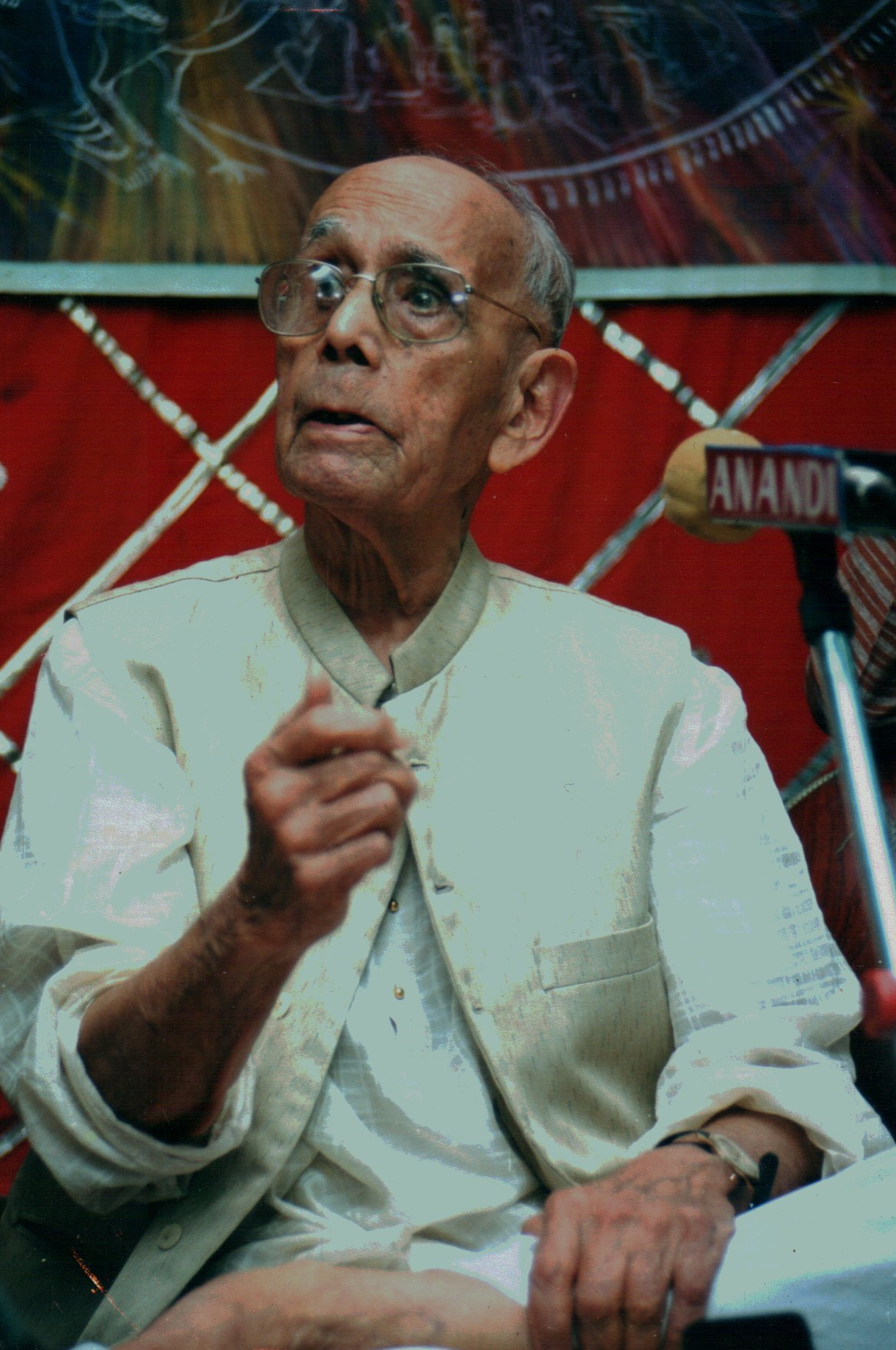
Bapu was the nephew of the Chapekar brothers, Damodar Hari, Vasudeo Hari and Balkrishna Hari, famous for their small but pivotal role in India’s independence movement.
Their sister was Bapu’s mother. The Chapekar brothers were hanged for assassinating Governor General W.C Rand in 1890. Bapu’s mother played a small role herself in the freedom movement by delivering secret messages for the legendary freedom fighter, Lokamanya Bal Gangadhar Tilak.
Bapu’s grandfather was Hari Vinayak Chapekar a well-known kirtankar. Perchance this is where Bapu picked up his genetic thread of an innate talent for music.
Early Years and music education:
Bapu grew up in and around Kurla and Thane. He did his schooling at King George High School in Matunga, a suburb of Mumbai. He was a staunch member of the RSS and an amateur wrestler, both from an early age.
His father Narayan Govind Kale was an employee of the Indian railways and an ardent music enthusiast. The young Bapu thus attended many private music mehfils (gatherings) along with his father and regularly heard prominent singers perform. Despite this early and frequent exposure to music, he didn’t start focusing on it until his twenties.
Bapu’s formal musical training was brief. He studied for a while in the Gwalior gharana tradition of music from Pandit Gangaprasad Pathak. He also briefly trained under Ustad Bhoorji Khansaheb (son of Ganamaharshi Ustad Alladiyan Khansaheb) of the Jaipur Gharana.
Truly, however, Bapu’s music was mostly self taught. He made it a point to evolve his music as an amalgamation of the styles of the various gharanas. He took great pleasure, for example, in the interval between two beats of a taal and his style of taking an aalap especially in the early portion of developing a raga was to follow a slow tempo, using pauses and fewer notes to accentuate beauty of the swaras being sung. His Vilambit aalapchari(आलापचारी) therefore followed the softer Kirana gharana style. His love for (आकारयुक्त दीर्घ आलापी) aakaryukti aalapi is a feature of the Jaipur school. His treatment of the words of the khayal, however, leaned towards the more aggressive Gwalior and Agra gharana styles.
Bapu was conferred the title of Sangeet-Teerth (संगीततीर्थ) by Shri Bukharisaheb of the Music School of Lucknow. Bukharisaheb was a well known figure in the field of Hindustani Classical music in the thirties.
Composing and teaching years:
Starting in his early twenties when Bapu looked to turn his love and talent for music into a career, he slowly began to find venues to perform in public.
The khayals that were sung during Bapu’s youth were mostly traditional ones. These were often handed down from teacher to student, parent to child over many generations. As a result many of the words in them were sometimes undecipherable when sung, often even unknown to the singers who merely mouthed unintelligible words to cover the gaps where the words had been long forgotten.
The establishment didn’t consider this an issue since they believed the khayal was merely the starting platform on which to build the much more important part of the repertoire—the actual development of the raga.
Bapu felt differently, however. He thought that the words of the khayal ought to be clear, precisely sung and if possible meaningful. The khayals were akin to lines of poetry in his opinion, set to a specific raga. Knowing the meaning of those lines would therefore add to the beauty of the raga being performed. Khayals needed reflect the mood of the raga—an upbeat song sung in a melancholy raga was ill fitting to it. Besides, there was also the time of the day the raga would be sung at to consider. These were all important to make the rendition of the khayal effective, in his opinion.
He slowly started composing khayals of his own. These he then began performing in public, often in mehfils attended by industry stalwarts. The khayals gained a lot of praise but only until the stalwarts learned that it was the young upstart musician who had composed them. Bapu’s compositions were often given the cold shoulder once their origin was known.
Undeterred Bapu realized that the way to get his compositions sung more widely was by teaching them to his own students. He soon started teaching Hindustani classical music. He taught both vocal music as well as harmonium playing. Bapu was as adept at playing the harmonium as he was a singer, once again a self taught skill. He was also a competent table player.
His humble composing and teaching genius:
Bapu’s compositions created over several years, number in the hundreds and are set in numerous Ragas. They are multi-varied in theme and also unusual in that they are often set to talas such as Ada Chautal, Roopak, Jhaptal and others which are not often heard in the more mainstream khayals.
Besides, Bapu also made the placement of the khayal within the rhythm interesting and often unpredictable, making the singing of it a challenge to the performer as well as those who accompanied the singer.
Bapu was a poet but a practical one. When asked by one of his students where he managed to get so many ideas for his various khayals, he merely brushed off the question saying it was nothing and wanted to discuss it no further.
Many of his students tell stories about the speed with which many of his compositions were created often during practice sessions or even at live performances.
One such is about a gat he created in the lilting Raga Kaustubh. It was created especially for the harmonium and is very versatile in that it can be played with many nuances and tempos and works especially well in a jugalbandi. It was one that was created during a music lesson for one of his students in a matter of an hour or so much to the student’s amazement.
A beautiful dhrut in Raag Marwa was created in a similar manner during an informal performance at a student’s home. There are also a few instances of compositions started by one of his students and completed by him or vice versa.
As a teacher Bapu, was a paragon of patience. Repeating as many times as might be necessary for the student to get the notes right be it using their voice or producing it on the harmonium, Bapu was always right there helping them on no matter how long it took. He was brilliant at getting the best out of each student and having them perform to the best of their ability.
He encouraged his students to always be positive and refused to accept their mention of defeat not only about musical matters but in their other life experiences as well. “I hate negativity,” he’d often say and not allow a student to utter the “I cannot do it,” words if he could help it.
Personal and later life:
Bapu married in 1940, at the age of 24 to the shy and unassuming 20 year old Kunda. They had one child who died an infant and later was born to them a daughter Mangal.
To support his family during his lean early years as a teacher and performer, Bapu supplemented his music income by delivering milk at dawn to households near Thane and Mulund. He also worked briefly cleaning cotton for mattresses. There is a story about his having encountered some stiff competition in the cotton cleaning trade. Some people even tried to use force to turn him away from the business. Thanks to training and strength as a wrestler he was able to take care of the situation. At any rate, the cotton work was affecting his health and his voice and as a result, he stopped.
Over the years, his pride of students in both the vocal and instrumental disciplines grew. And his reputation for being a great teacher began to spread. He started becoming selective about whom he chose to teach.
He realized his dream. His compositions began getting several new and varied, often extremely talented voices besides his own.
Over time he became Pandit Vinayak Narayan Kale—music teacher extraordinaire.
Every year Bapu conducted one large scale Gurupoornima program where he showcased the talents of his students, taking great care about the order in which the performances were placed and the ragas each student was assigned. Throughout the year several smaller baithaks were conducted to celebrate various festivals such as Gudi Padwa, Diwali and Dussera. These were all not only opportunities for students to perform in public, they were also a place for younger students to hear the more seasoned students who were becoming excellent musicians in their own right.
Bapu has touched the lives of many who were fortunate enough to be taught by him and several hundreds of others who have heard him perform as a singer or on the harmonium.
He kept a tough schedule. He taught music from dawn until dusk with a small break for lunch and a siesta, seven days a week. And somehow he was able to take equal pleasure in the last student of the day as he did in the first.
He managed to keep this routine going almost until his last days. He passed away peacefully and content on Oct 2, 2001.
Today he is survived by his daughter Mangal, his devoted students who continue to sing and perform, and by his wondrous khayals.
Parasgandha:
Bapu’s Khayals are collected in a volume ‘Parasgandha’ with the Ragas organized according to the Samay Chakra. Please email Ranjini at ranjini.iyer@gmail.com if interested in this collection.
 Pandit Vinayak Rao Kale
congratulations !! what a fitting tribute to a wonderful teacher and a nurturing Guru!
Thank you for opening world of kale guruji’s music to Hindustani classical enthusiasts
saroj Datar – Apte.
Thank you so much to all those who are responsible for this page.My son and myself were sir’s student for 4yrs. I have tested sir’s patience a lot.
If I remember correctly sir attained the lord’s feet on 4th october 2002 and not 2001.
pardon me if I am wrong.
I have admired some of sir’s students like, leelaji, vidula bhagwat, joshiji and many others who have been associated with sir closely.
Thank u all once again for this page. I am too overwhelmed for words. I would like to convey my regards to mangal thayi.
I had the good fortune of learning music from Bapu for a short while when I was in Thane over 35 years ago . Remember him with great fondness 🙏. I have re started music lessons recently after my retirement and was wondering if anyone could help me with the lyrics of Hey Devi Sharadhe which Bapu taught to his junior students .
Hello Preeti, lovely to hear from you. I’ll get you the lyrics for the song. I never sang it myself but i can find them for you. Please email me at ranjini.iyer@gmail.com.